
 EN
How Does Flanged Butterfly Valve Support Large Pipes?
For large-diameter piping, a Flanged Butterfly Valve is often selected because its body has integral end flanges that bolt directly to the mating pipe flanges. From an industrial-valve application engineer’s perspective, that feature matters because it creates a defined, bolted connection at each end of the valve. It does not mean the valve should be treated as a substitute for engineered pipe supports. The useful question is how a Flanged Butterfly Valve fits into the load path, alignment process, sealing arrangement, and operating plan for a large line.
Large pipes bring more than a larger nominal diameter. Their filled weight, thermal movement, vibration, actuator mass, and installation tolerances can all affect the valve station. A suitable Flanged Butterfly Valve helps establish a robust connection between pipe sections when its flange pattern, pressure-temperature rating, materials, gasket, bolts, and disc clearance are confirmed for the actual service.
What the integral flanges contribute
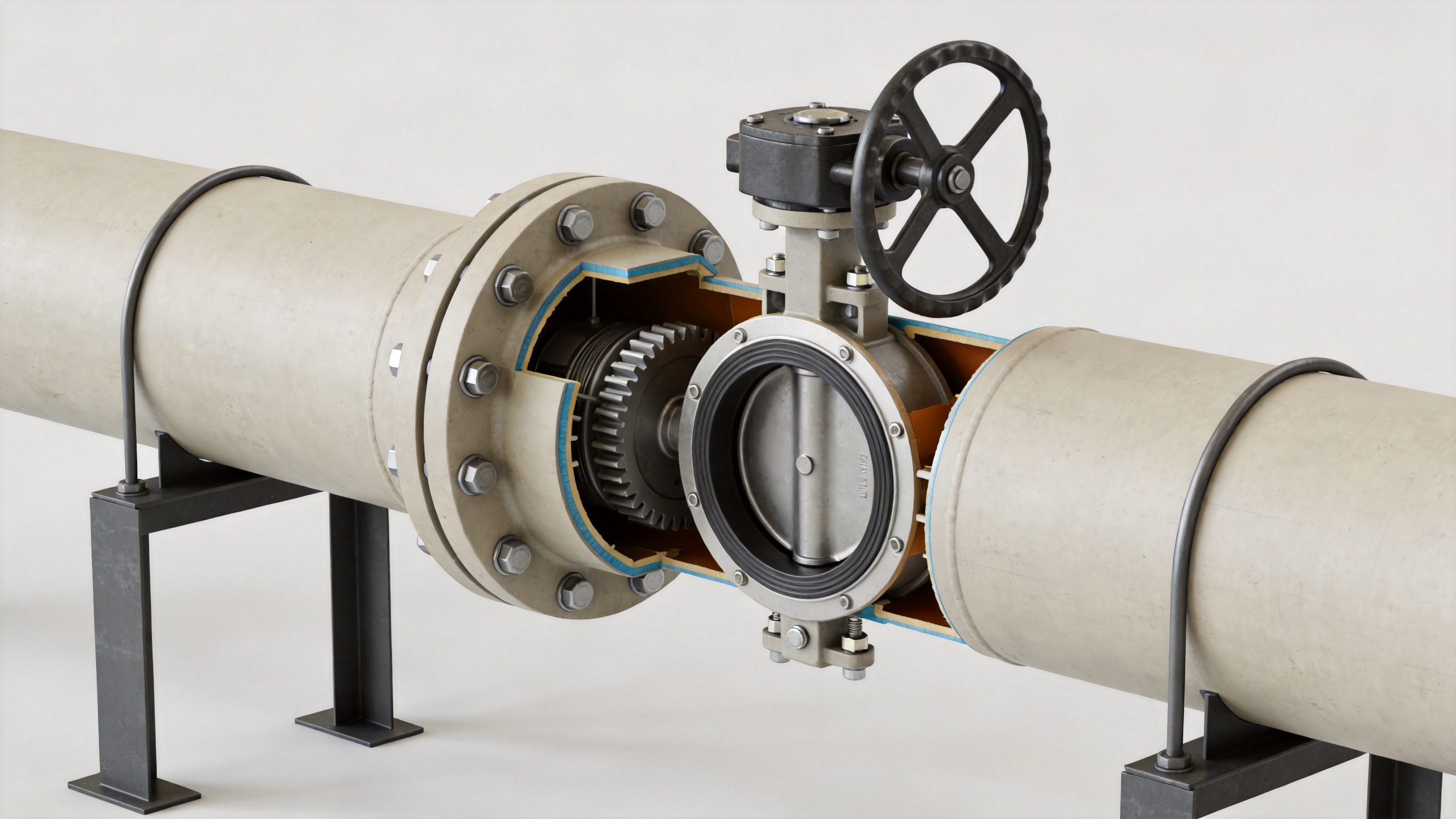
A Flanged Butterfly Valve has a flange face on each end of the body. During installation, bolts clamp the valve, gaskets, and pipe flanges into a joint. This differs from a wafer-style arrangement that is held between separate line flanges. In a large-pipe layout, the integral flanges can make the valve position easier to define and give the installation team a direct bolting arrangement on both sides.
The flanges help transfer the joint-clamping force around the connection, but their role needs to be stated carefully. They do not automatically resolve bending loads from unsupported pipe, settlement, or misalignment. Those loads must be considered by the piping designer and support layout. A Flanged Butterfly Valve is one component in the line; adjacent guides, hangers, anchors, and supports determine how the whole assembly behaves.
Why alignment matters more as pipe size increases
Before bolts are tightened, the mating pipe flanges should be brought into position without using the valve body as a tool to pull a misaligned line together. Installation guidance for flanged butterfly valves emphasizes alignment of the connecting pipe flanges before mounting. That principle is especially relevant on large pipes, where a small positional error can create a noticeable lever arm across the joint.
Start by checking face parallelism, bolt-hole alignment, available clearance for the disc, and the orientation of the stem or gearbox. Then confirm that temporary installation supports hold the pipe safely while the Flanged Butterfly Valve is positioned. Tightening should follow the approved project procedure and gasket supplier guidance. The aim is an even, properly assembled joint, not merely a connection that can be forced closed with bolts.
How the valve fits into the pipe-support strategy
The valve body and its flanges must be selected for the stated line conditions, while the pipe-support design must manage the line’s dead weight and movement. In practical terms, supports near a Flanged Butterfly Valve should be reviewed together with the valve’s mass, the weight of an actuator or gear operator, and the stiffness of nearby pipe. If an automated valve is mounted high in a rack, the actuator can alter the local center of gravity. This is not just a valve-body question; the operator, bracket, controls, and support arrangement need to work together.
A useful engineering review separates four load sources: pipe weight, fluid weight, operational forces, and thermal movement. The selected Flanged Butterfly Valve should be checked against the project’s allowable loads and installation requirements. The piping team should decide where supports and guides belong. Avoid assuming that a bolted valve connection can absorb all pipe strain simply because it has flanged ends.
Confirm the flange connection, not only the nominal size
Nominal pipe size alone is not enough to specify a Flanged Butterfly Valve. The connecting flanges must share a compatible standard, pressure class or PN designation, facing arrangement, bolt pattern, and gasket concept. As one example, ASME B16.5 covers pipe flanges and flanged fittings from NPS 1/2 through NPS 24 and includes requirements associated with flange bolting, gaskets, and flange joints. Whether that standard applies to a particular project is a specification question, not an assumption.
For lines outside that size range or under another regional standard, request the applicable project documents and dimensional data. More accurately, do not ask only, “Is this a flanged valve?” Ask whether the Flanged Butterfly Valve and both mating flanges are compatible under the required standard and service conditions.
Choose materials and sealing for the actual medium
Large-pipe service can involve water, wastewater, process fluids, gases, or slurry-like media. The body, disc, stem, seat, and gasket must be reviewed against the medium, temperature, pressure, and cycling requirement. A Flanged Butterfly Valve that is suitable for a stable water line may need a different seat or material combination when the medium, temperature, or chemical exposure changes.
Related valve terms should not be mixed into the selection. A stainless steel ball check valve addresses backflow control through a different valve mechanism; it is not an alternative description for a butterfly isolation or throttling valve. Likewise, an equilibrium float valve is associated with level-control functions. These valves can appear in the same water or process system, yet each should be specified by its own duty.
Operating torque and access are part of support planning
On a large line, a manual gearbox, pneumatic actuator, or electric actuator can influence valve-station space and support needs. Confirm the required operating torque with the supplier using actual differential pressure, media, operating frequency, and disc condition. Then verify actuator orientation, access for commissioning, cable or air routing, and maintenance space. A Flanged Butterfly Valve may be compact relative to other valve types, but a complete automated assembly still needs room to operate and be serviced.
During procurement, it is sensible to distinguish confirmed information from items that need documentation. Product drawings, face-to-face dimensions, torque information, flange details, pressure-temperature limits, and installation guidance should be requested for the configured valve. That approach supports clear technical communication without turning a generic valve description into an unverified performance claim.
A practical large-pipe checklist
- Confirm the medium, solids content, pressure, temperature, flow direction, and cycling duty.
- Match the Flanged Butterfly Valve flange dimensions and rating to the two mating pipe flanges.
- Verify disc clearance at the pipe bore and any adjacent fittings.
- Plan supports, anchors, and guides for pipe weight, fluid weight, thermal movement, and actuator mass.
- Align pipe flanges before inserting the valve; do not use bolts to correct major line offset.
- Confirm gasket, bolting, tightening sequence, and inspection requirements from the applicable project documents.
- For automated service, verify torque, fail position, control signal, power or air supply, and access space.
The key takeaway
A Flanged Butterfly Valve supports large-pipe installations by providing an integral, bolted connection that helps position the valve in a properly designed piping assembly. Its value comes from a compatible flange connection, controlled alignment, suitable materials and sealing, and coordination with the pipe-support and actuator plan. If the service conditions are still incomplete, list the known conditions and the open questions before selecting the final Flanged Butterfly Valve configuration.
 Hot News





