
 EN
What Is Butterfly Valve And How It Works In Pipelines?
A butterfly valve is a flow-control device with a circular disc that rotates inside a pipe. Turn the disc across the flow path and it meets a seat to close the passage; turn it toward the flow direction and the passage opens. The device can isolate a line or, when its design and controls allow, regulate flow. For a pipeline operator, the important question is not just how it turns, but whether the valve, seat and actuator suit the actual service.
What makes up a butterfly valve?
The body connects the assembly to the pipeline. Inside it, the disc is attached to a shaft, also called a stem. The shaft transmits movement from a handle, gearbox or actuator to the disc. A seat provides the contact surface at closure, while bearings or bushings support the shaft. Sealing arrangements vary with design, so a drawing of the specific assembly is more useful than assuming every unit has identical parts.
In a resilient-seated butterfly valve, the disc closes against a flexible seat. Other designs use different seat materials and offset geometries for different duties. Body, disc, shaft and seat must all be compatible with the fluid and its temperature. A valve that fits the pipe diameter is not necessarily suitable for the pressure or chemistry in that pipe.
How does a butterfly valve work in a pipeline?
A butterfly valve is generally a quarter-turn valve. From the closed position, its shaft rotates the disc approximately 90 degrees to the open position. The actual end stops and allowable travel are defined by the valve and actuator. In the open position the disc is roughly parallel to the flow, although it remains in the flow path. In the closed position it is across the passage and contacts the seat.
The sequence is straightforward: a manual or automatic drive applies torque to the shaft; the shaft turns the disc; and the disc angle changes the opening available to the fluid. At an intermediate angle, a butterfly valve restricts the passage. Pressure loss, flow rate and the forces on the disc depend on the installation and operating conditions, not on disc angle alone.
Closing is not the same as providing an independent safety isolation. Leakage class, pressure direction and the intended service should be checked against the manufacturer's documentation. Follow the site's isolation procedure before maintenance, including depressurizing and draining the affected section where required.
On-off duty or flow regulation?
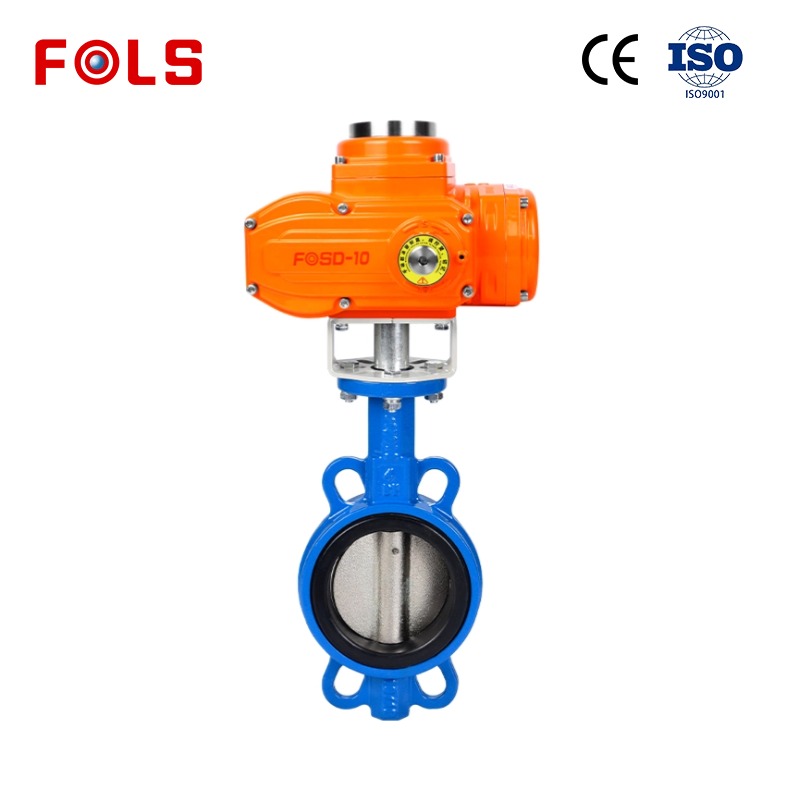
For on-off duty, the butterfly valve moves between the specified open and closed stops. A lever can be practical where a person operates an accessible valve. A gearbox may be used when manual operation requires more mechanical advantage. Remote installations often use electric or pneumatic drives, with position indication supplied where the control system requires it.
For regulation, the disc is held at an intermediate position. Not every butterfly valve or actuator is intended for frequent modulation. Ask for the flow characteristics, operating range and actuator duty rating for the proposed assembly. A control loop must also account for the rest of the pipeline, including pump behavior and variations in differential pressure.
Operating near a nearly closed position can introduce high local velocities, noise or wear in some services. Liquid pressure conditions can also create cavitation. These are system-dependent risks rather than automatic faults: an engineer should assess the duty and the supplier's limits before specifying the control arrangement.
How do electric actuators move the disc?
The electric actuator working principle is to convert electrical power into mechanical movement. For a butterfly valve, an electric motor and gearing commonly provide the rotary output needed to turn the shaft. Controls send an open, close or positioning command, while limit switches or other feedback devices can indicate travel. The available features depend on the selected actuator.
A motorized linear actuator produces movement along a straight line, not the quarter-turn shaft motion described above. It can operate a rotary valve only if an appropriately engineered linkage or conversion mechanism is provided. Do not assume that a linear output can be coupled directly to the valve stem or that any actuator has the correct mounting and travel.
Actuator selection starts with the valve manufacturer's torque data for the specific butterfly valve and its service conditions. Opening, running and seating torque may differ. Compare the required torque through travel with the actuator's available output at the actual supply conditions, and use the project-approved margin. Also confirm voltage, control signal, enclosure suitability, operating frequency and the required response to loss of power.
Where can a butterfly valve be used?
A butterfly valve may be considered for water distribution, treatment systems, building services and industrial process lines. In a hypothetical water-treatment branch, for example, an operator may need to isolate a section for service while keeping access to the drive. The choice still depends on the fluid, solids, pressure, temperature, required leakage performance and pipe connections. A wastewater application can impose different demands from a clean-water line even when both use the same nominal pipe size.
Space is another practical consideration. A butterfly valve can offer a compact face-to-face arrangement, but the disc needs clearance as it rotates. Nearby pipe linings, bends, flanges and adjacent equipment should be checked against the manufacturer's installation instructions. Connection styles such as wafer, lug and flanged designs also impose different installation and maintenance requirements.
What should buyers check before specifying one?
- Service conditions: identify the medium, concentration, operating and design pressure, temperature, flow direction and any solids or cleaning chemicals.
- Valve assembly: confirm pipe size, connection standard, body and disc materials, seat compatibility and required shutoff performance for the stated conditions.
- Operation: state whether the butterfly valve is for isolation or modulation, how often it cycles, and whether local or remote control is needed.
- Actuation: provide the maximum differential pressure during movement and request torque data, mounting details, power or air requirements and position feedback options.
- Installation: verify disc clearance, pipe support, orientation, maintenance access and the commissioning checks specified for the assembly.
How should a pipeline team approach maintenance?
Follow the valve supplier's inspection and maintenance instructions rather than applying a generic interval to every butterfly valve. Depending on service, the team may inspect for external leakage, damage to the drive, unusual operating torque and signs of seat wear. Compare position indication with the actual operating procedure, and document any change in behavior for investigation.
Before any work, isolate the equipment under the site's approved procedure and verify that pressure and stored energy are controlled. Do not loosen a connection or remove an actuator from a pressurized line based only on a position indicator. A practical record of the fluid, cycle frequency and observed issues gives the supplier a useful basis for troubleshooting.
Putting the operating principle to work
The defining movement of a butterfly valve is simple: a rotating disc changes the available passage and meets a seat at closure. The specification is less simple because the valve and its drive must work together under real pipeline conditions. Start with the medium and duty, then confirm materials, shutoff requirements, torque and installation clearance with the supplier before deciding on a configuration.
 Hot News





